A Hero and a Crown
This article is distributed by NASA Night Sky Network
By Vivian White
High in the summer sky, the constellation Hercules acts as a centerpiece for late-night stargazers. At the center of Hercules is the “Keystone,” a near-perfect square shape between the bright stars Vega and Arcturus that is easy to recognize and can serve as a guidepost for some amazing sights. While not the brightest stars, the shape of the hero’s torso, like a smaller Orion, is nearly directly overhead after sunset. Along the edge of this square, you can find a most magnificent jewel – the Great Globular Cluster of Hercules, also known as Messier 13.
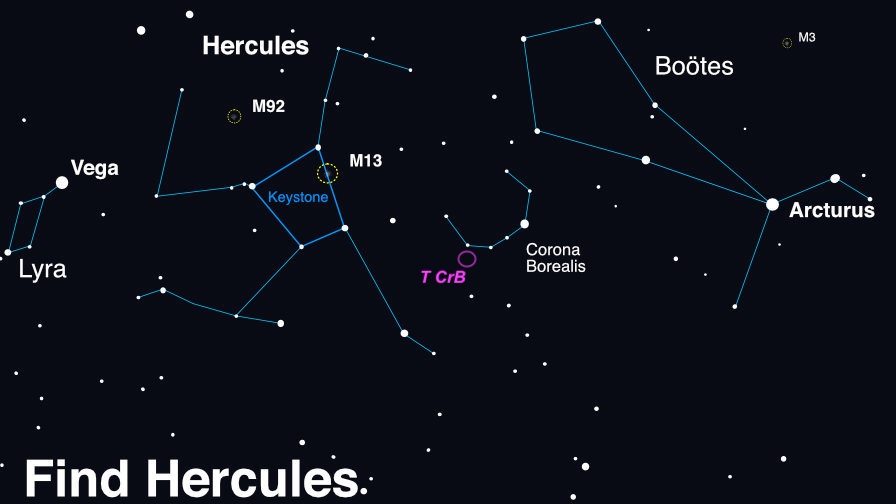
Look up after sunset during summer months to find Hercules! Scan between Vega and Arcturus, near the distinct pattern of Corona Borealis. Once you find its stars, use binoculars or a telescope to hunt down the globular clusters M13 (and a smaller globular cluster M92). If you enjoy your views of these globular clusters, you’re in luck – look for another great globular, M3, in the nearby constellation of Boötes. Image created with assistance from Stellarium: stellarium.org
Globular clusters are a tight ball of very old stars, closer together than stars near us. These clusters orbit the center of our Milky Way like tight swarms of bees. One of the most famous short stories, Nightfall by Isaac Asimov, imagines a civilization living on a planet within one of these star clusters. They are surrounded by so many stars so near that it is always daytime except for once every millennium, when a special alignment (including a solar eclipse) occurs, plunging their planet into darkness momentarily. The sudden night reveals so many stars that it drives the inhabitants mad.
Back here on our home planet Earth, we are lucky enough to experience skies full of stars, a beautiful Moon, and regular eclipses. On a clear night this summer, take time to look up into the Keystone of Hercules and follow this sky chart to the Great Globular Cluster of Hercules. A pair of binoculars will show a faint, fuzzy patch, while a small telescope will resolve some of the stars in this globular cluster.
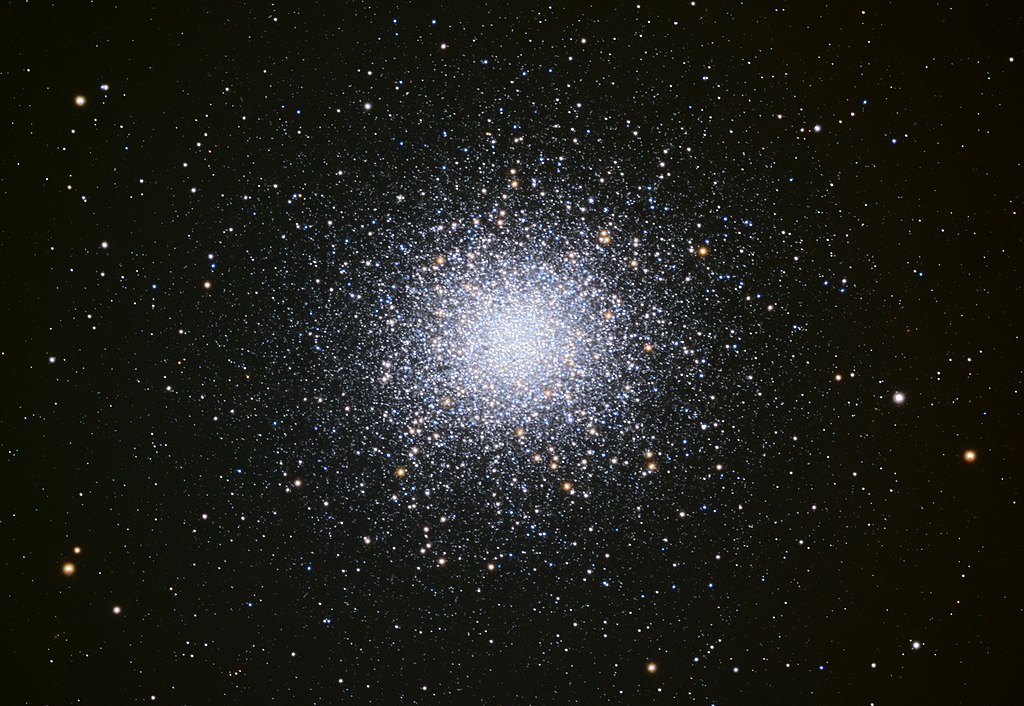
Sid Leach/Adam Block/Mount Lemmon SkyCenter